Let’s face it, golf is not an easy game to master. It can take years trying to lower your scores by a couple of strokes and there are rarely any shortcuts. But… you can play better golf by making the most of your rangefinder.
 The obvious advantage to having a golf rangefinder, is that you will make better club selections when you know exactly how far you need to hit it. Simply using a laser or GPS will help most golfers improve their games over time. You can take that a step further and really learn how far you hit each of your clubs and what factors affect your ball flight the most.
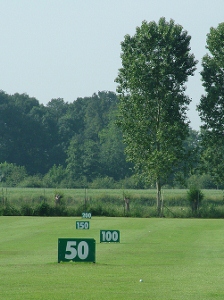
Everybody knows what club they hit from the 100 or 150 yard marker. For every 10 yards we are from the marker, we add or subtract a club. If that’s not your formula, you probably have something pretty similar. It’s a nice “in the ball park” formula, but there’s a good chance that if you take a little time and effort with your golf rangefinder, you’ll learn some very valuable lessons about your distances.
Stick a small notebook in your golf bag so you’ll be able to take notes during your next few rounds of golf. At first, you’ll want to do this on calm days and shots with very little elevation change, so you don’t have to guess at how much the wind might be affecting your ball flight.
If you have a GPS rangefinder that has shot-measuring capabilities, learn how to use it. Some of these units, like the Garmin G6, will even allow you to store shot distances for each club. That can make your job much easier. Whether you are recording in a notebook or on the GPS, remember there are two distances that you need to know – your total shot distance is important, but not nearly as important as your carry distance. The reason of course, is that on a wet golf course you won’t get nearly as much roll as on a dry course, so total distance won’t be as long. Your carry distances (how far the ball flies) should be the same on a wet or dry course. Depending on the conditions, you’ll be better prepared to choose the right club.
So time permitting, each time you hit a decent shot, you’ll want to record the club used, the carry distance and the total distance. To calculate the carry distance, you’ll need to have made a ball mark when the ball landed. If you’re using laser, pace from the pin to your ball and to your ball mark and add or subtract to or from the distance you had planned to hit. If you are using a GPS that doesn’t have shot distance measuring, you’ll pace to your ball and ball mark from the middle of the green to make your calculations. If you have the notebook in your back pocket, you can write it down quickly so you don’t distract yourself trying to remember it while putting!
It will take a few rounds to get a full picture of your game, but you will have learned something with each shot recorded and your scores will likely start to come down. You’ll even begin to get a feel for how much elevation changes and wind are affecting your shots and I bet you’ll be surprised.
You don’t have to learn it all at once and you won’t want to take notes at the expense of losing the rhythm of your game. Sometimes you’ll have time to take notes and sometimes you won’t. Don’t sweat it. Just know that you’ll reap the benefits in the very near future!
 Talkin' Golf on Google+
 Reviews on YouTube
 Twitter
 Like us on Facebook
 RSS
RSS
Leave a Comment or Ask a Question!